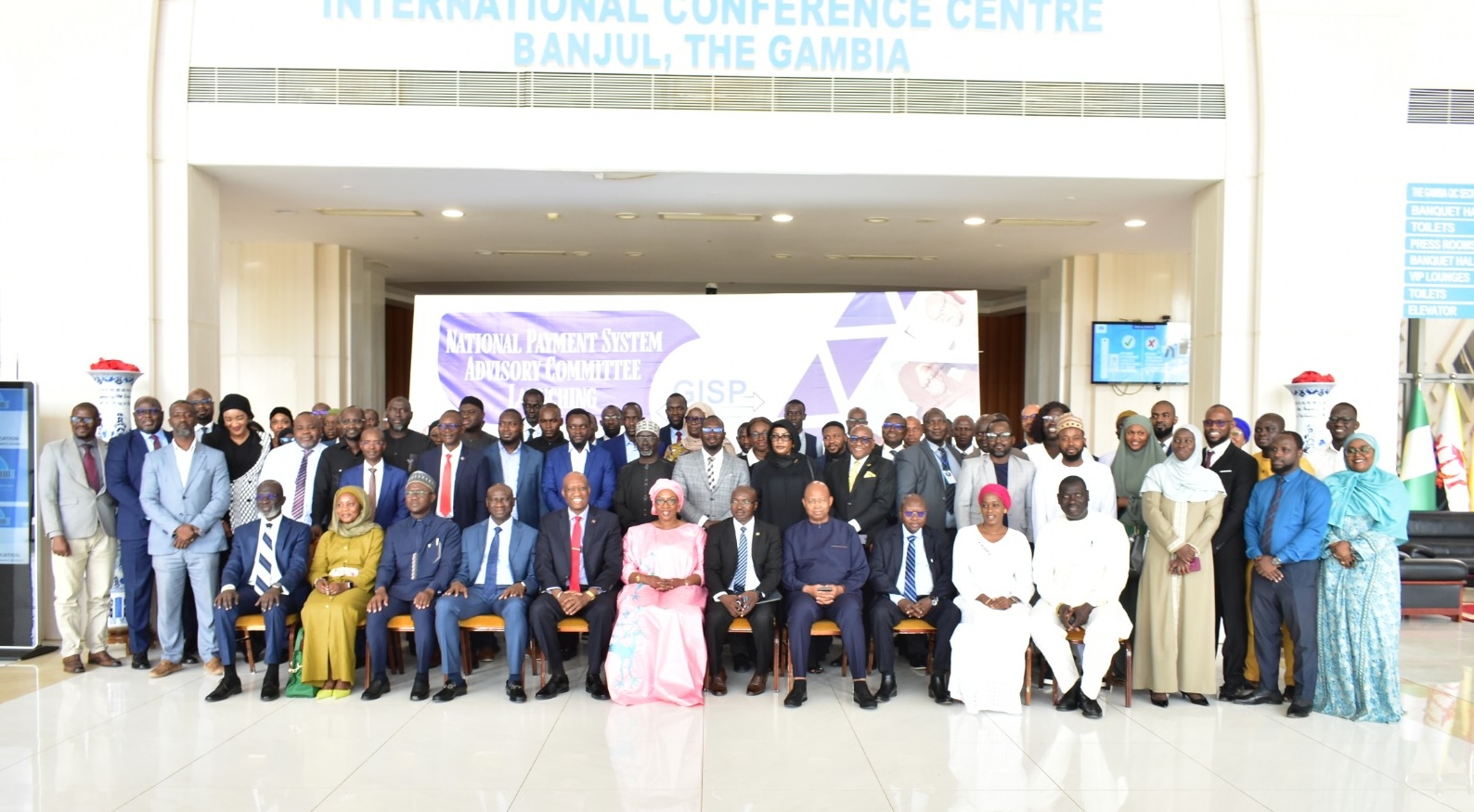

On Monday 23rd February, 2026 marked a historic milestone in The Gambia’s Digital financial transformation as the National Payment Systems Advisory Committee (NPSAC) was officially launched under the guidance of the Central Bank of The Gambia, in collaboration with the Ministry of Communications and Digital Economy and the Institute for Inclusive Digital Africa among other strategic partners to strengthen payment system governance and accelerate financial inclusion.
The launch, held at the Sir Dawda Kairaba Jawara International Conference Center, brought together dignitaries and key stakeholders from across government institutions, financial institutions, development partners, and international delegates, including representatives from Institution for Inclusive Digital Africa (IIDiA).
In his welcoming remarks, Mr. Karamo Jawara, Director of Banking and Payment Systems at the Central Bank of The Gambia, described the establishment of NPSAC as more than a ceremonial event. He emphasized that it represents a strategic and structured step toward aligning The Gambia’s payment systems with international best practices under the Payment Systems Act of 2016. He highlighted that the Committee will be supported by six specialized Working Groups focusing on digital standards, innovation, legal compliance, operational resilience, fair pricing, financial accessibility, public awareness, and capacity development—ensuring depth, expertise, and coordinated progress across the ecosystem.
The Commissioner General of the Gambia Revenue Authority, Mr. Yankuba Darboe, delivered a powerful address linking modern payment systems directly to national development. He stressed that efficient, transparent digital payments strengthen revenue collection, combat fraud, and formalize the economy. According to him, digital payment rails enhance accountability, simplify tax compliance for businesses, and support automated reconciliation systems that build public trust in national institutions.
On behalf of the Institute for Inclusive Digital Africa (IIDiA), Niania Dabo, Director of Development and Partnership, extended appreciation to the Central Bank of The Gambia for its leadership in convening this multi-stakeholder platform, and to the Ministry of Communications and Digital Economy, development partners, and ecosystem actors whose collaboration made the moment possible. She affirmed that “We conceived, tested, and launched BANTABA 2.0, The Gambia's first real-time fully interoperable payment system,” acknowledging the Central Bank of Rwanda and the World Bank for their technical support and shared expertise. Describing it as “Pan-African solidarity in action,” she noted that while BANTABA 2.0 is now live and the technology backbone proven, the establishment of NPSAC will ensure that institutional coordination, consumer protection, fair pricing, and risk management evolve alongside innovation, building trust and advancing national financial inclusion priorities.
Delivering the keynote address, the Governor of the Central Bank of The Gambia, Mr. Buah Saidy, outlined the significant strides already made in modernizing the country’s financial infrastructure, including upgrades to the Real-Time Gross Settlement (RTGS) system, compliance with ISO 20022 global standards, enhancements to the Automated Clearing House (ACH), and integration between the Central Bank’s core banking system and government financial systems. However, he also candidly acknowledged existing challenges such as cybersecurity threats, mobile money fraud, scalability gaps, and interoperability issues; highlighting that the formation of NPSAC is a strategic governance response to these emerging complexities.
In his official launch speech, Hon. Lamin Jabbi, Minister of Communications and Digital Economy, framed digital payments as the backbone of modern economic transformation. He underscored that digital payments are no longer a luxury but a necessity, representing the fastest migration of value in human history. Citing global trends from India, Brazil, and Kenya, he emphasized that adoption, not population size, defines success in digital economies. He called on the Committee to prioritize speed, security, stability, inclusion, and strong regulatory coordination between institutions such as the Central Bank, PURA, and other stakeholders. He further noted that digital payments drive GDP growth, reduce informality, enhance transparency, and empower marginalized communities.
The Minister formally launched the Committee, describing payments as not just financial infrastructure, but digital public infrastructure foundational to entrepreneurship, government service delivery, and national competitiveness.
The establishment of NPSAC represents a coordinated, multi-institutional commitment to building a secure, inclusive, interoperable, and future-ready payment system; positioning The Gambia firmly on the path toward a resilient and digitally empowered economy.
The launch, held at the Sir Dawda Kairaba Jawara International Conference Center, brought together dignitaries and key stakeholders from across government institutions, financial institutions, development partners, and international delegates, including representatives from Institution for Inclusive Digital Africa (IIDiA).
In his welcoming remarks, Mr. Karamo Jawara, Director of Banking and Payment Systems at the Central Bank of The Gambia, described the establishment of NPSAC as more than a ceremonial event. He emphasized that it represents a strategic and structured step toward aligning The Gambia’s payment systems with international best practices under the Payment Systems Act of 2016. He highlighted that the Committee will be supported by six specialized Working Groups focusing on digital standards, innovation, legal compliance, operational resilience, fair pricing, financial accessibility, public awareness, and capacity development—ensuring depth, expertise, and coordinated progress across the ecosystem.
The Commissioner General of the Gambia Revenue Authority, Mr. Yankuba Darboe, delivered a powerful address linking modern payment systems directly to national development. He stressed that efficient, transparent digital payments strengthen revenue collection, combat fraud, and formalize the economy. According to him, digital payment rails enhance accountability, simplify tax compliance for businesses, and support automated reconciliation systems that build public trust in national institutions.
On behalf of the Institute for Inclusive Digital Africa (IIDiA), Niania Dabo, Director of Development and Partnership, extended appreciation to the Central Bank of The Gambia for its leadership in convening this multi-stakeholder platform, and to the Ministry of Communications and Digital Economy, development partners, and ecosystem actors whose collaboration made the moment possible. She affirmed that “We conceived, tested, and launched BANTABA 2.0, The Gambia's first real-time fully interoperable payment system,” acknowledging the Central Bank of Rwanda and the World Bank for their technical support and shared expertise. Describing it as “Pan-African solidarity in action,” she noted that while BANTABA 2.0 is now live and the technology backbone proven, the establishment of NPSAC will ensure that institutional coordination, consumer protection, fair pricing, and risk management evolve alongside innovation, building trust and advancing national financial inclusion priorities.
Delivering the keynote address, the Governor of the Central Bank of The Gambia, Mr. Buah Saidy, outlined the significant strides already made in modernizing the country’s financial infrastructure, including upgrades to the Real-Time Gross Settlement (RTGS) system, compliance with ISO 20022 global standards, enhancements to the Automated Clearing House (ACH), and integration between the Central Bank’s core banking system and government financial systems. However, he also candidly acknowledged existing challenges such as cybersecurity threats, mobile money fraud, scalability gaps, and interoperability issues; highlighting that the formation of NPSAC is a strategic governance response to these emerging complexities.
In his official launch speech, Hon. Lamin Jabbi, Minister of Communications and Digital Economy, framed digital payments as the backbone of modern economic transformation. He underscored that digital payments are no longer a luxury but a necessity, representing the fastest migration of value in human history. Citing global trends from India, Brazil, and Kenya, he emphasized that adoption, not population size, defines success in digital economies. He called on the Committee to prioritize speed, security, stability, inclusion, and strong regulatory coordination between institutions such as the Central Bank, PURA, and other stakeholders. He further noted that digital payments drive GDP growth, reduce informality, enhance transparency, and empower marginalized communities.
The Minister formally launched the Committee, describing payments as not just financial infrastructure, but digital public infrastructure foundational to entrepreneurship, government service delivery, and national competitiveness.
The establishment of NPSAC represents a coordinated, multi-institutional commitment to building a secure, inclusive, interoperable, and future-ready payment system; positioning The Gambia firmly on the path toward a resilient and digitally empowered economy.